
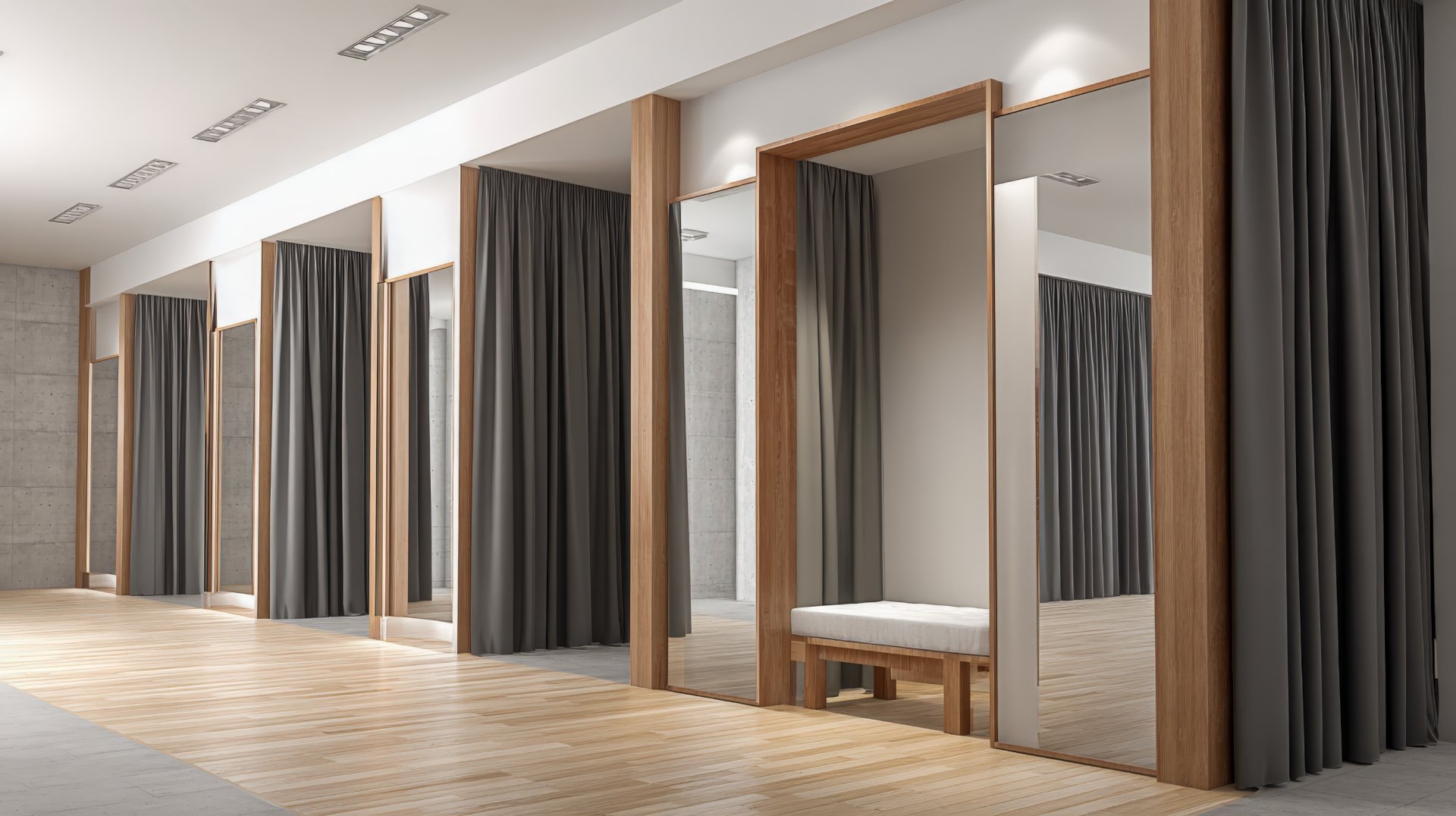
Fitting room curtains influence how customers feel, move and make decisions inside a retail space. They affect privacy, acoustics, hygiene, durability and store presentation. When specified well, they support smooth operations and help protect merchandise. When specified poorly, they create frustration for staff and customers alike.
Retail research consistently shows that the fitting room plays a decisive role in purchase conversion. Several global retail studies report that a high percentage of shoppers are more likely to buy after trying on garments. That makes the fitting room one of the most commercially sensitive areas in a store. Curtains in this space must perform reliably, withstand frequent use and maintain their appearance over time.
This guide outlines best practices for specifying and installing fitting room curtains in fashion retail, department stores, boutiques and specialty environments.
Start With Privacy and Coverage
Privacy is the primary function of a fitting room curtain. Customers need full visual screening from all external angles, including from below and above.
To achieve this:
- Ensure curtain width provides adequate fullness. A minimum of 1.8 to 2.2 times track width delivers proper coverage and reduces light gaps.
- Specify sufficient drop length. Curtains should finish close to the floor without dragging. A clearance of 10 to 20 millimetres helps prevent wear and simplifies cleaning.
- Avoid lightweight sheer fabrics. Use medium to heavy weight fabrics with tight weaves.
- Consider lining. A separate lining improves opacity and adds structure.
In high traffic stores with bright lighting, thin fabrics can silhouette the customer. Always test opacity under store lighting conditions before final approval.
Choose Fabrics for Durability and Maintenance
Fitting room curtains endure constant handling. Customers pull them open and closed repeatedly. Staff often tie them back or adjust them during cleaning.
Fabric selection must reflect this reality.
Look for:
- High abrasion resistance. Review Martindale or Wyzenbeek ratings where available.
- Dimensional stability. Fabrics should resist shrinkage and stretching.
- Colourfastness to light. Fitting rooms often use strong artificial lighting.
- Easy clean properties. Some environments require frequent laundering or wipe down protocols.
Polyester blends often perform well in retail due to durability and resistance to creasing. In higher end boutiques, textured fabrics can enhance ambience while still offering strength.
Always confirm fire performance requirements. Many retail settings require compliance with relevant Australian fire standards. Using tested and certified fabrics reduces risk and ensures smoother approvals.
Address Fire Compliance Early
Retail environments fall under commercial building classifications. Curtains may need to meet specific fire performance standards depending on local regulations and tenancy agreements.
Specify fabrics that comply with relevant Australian standards such as AS 1530 or AS 3837 where required. Keep documentation on file for building managers and auditors.
Avoid retrofitting fire treatments after installation. Some treatments affect fabric hand, drape and longevity. Selecting inherently fire resistant fabrics from the outset provides more predictable performance.
Track Systems and Hardware Selection
The curtain track system is often overlooked, yet it determines how the curtain performs day after day.
Key considerations include:
Load capacity
Ensure the track supports the combined weight of curtain and lining. Overloading a lightweight system leads to sagging and premature failure.
Smooth operation
Customers expect curtains to glide easily. Friction or sticking creates frustration and can damage fabric over time. Aluminium tracks with quality carriers tend to offer reliable movement.
Mounting method
Tracks can be ceiling mounted or face fixed. Ceiling mounting often creates a cleaner look and improves privacy by reducing light gaps. In existing fitouts, face fixing may be more practical.
Shape and configuration
Curved tracks are common in fitting rooms to create semicircular enclosures. Confirm bend radius limits with the manufacturer. Poorly executed curves affect carrier movement.
Maintenance access
Retail stores require simple maintenance procedures. Tracks should allow easy removal and reinstallation of curtains without specialist tools.
Acoustic Considerations
Hard retail environments with polished floors and reflective surfaces often generate noise. Curtains help absorb sound and reduce echo inside fitting rooms.
Heavier fabrics with lining improve acoustic absorption. While curtains alone will not solve major acoustic issues, they contribute to a more comfortable environment.
Customers who feel at ease tend to spend more time trying on garments. Reduced noise also supports clearer communication between staff and customers.
Hygiene and Cleaning Protocols
Hygiene standards have increased across retail environments. Fitting room curtains should support regular cleaning without degrading quickly.
Consider:
- Removable designs with easy access hooks or snap tape.
- Washable fabrics that maintain colour and structure after laundering.
- Stain resistant finishes where appropriate.
Establish a cleaning schedule during project handover. Staff should know how to remove and reinstall curtains safely.
Sizing and Fullness Calculations
Underestimating fullness leads to thin, stretched curtains that look flat and fail to provide adequate screening.
Calculate fabric requirements carefully:
- Measure finished track width.
- Multiply by chosen fullness ratio.
- Add allowances for hems and headings.
For example, a 1200 millimetre track with 2 times fullness requires at least 2400 millimetres of fabric width before hems. Always confirm fabric usable width from the supplier.
Headings and Attachment Methods
The heading style affects both aesthetics and function.
Common options include:
- Eyelet headings for a contemporary look.
- Hook and tape systems for easy removal.
- Wave headings where a uniform ripple effect is desired.
In high turnover retail, hook and tape systems often offer practical advantages. They allow quick removal for cleaning and replacement.
Avoid complex decorative headings that slow maintenance or increase snag risk.
Lighting Interaction
Fitting room lighting significantly influences customer perception of garments. Curtains interact with this lighting.
Dark fabrics absorb light and create a more intimate feel. Lighter colours reflect light and can brighten small spaces.
Test curtain samples under the actual fitting room lighting plan. Consider how fabric colour influences skin tones and garment colours. Retailers often prefer neutral shades that flatter a wide range of customers.
Avoid high gloss finishes that may create glare.
Brand Alignment and Interior Cohesion
Fitting room curtains should align with the store’s broader interior concept.
In luxury boutiques, heavier textured fabrics reinforce quality and attention to detail. In fast fashion environments, simpler and more robust materials may suit the operational focus.
Consider:
- Colour coordination with wall finishes.
- Contrast or tonal blending.
- Consistency across multiple store locations.
A standardised specification across a retail network simplifies procurement and maintenance while supporting brand identity.
Accessibility and Inclusivity
Accessible fitting rooms require careful curtain planning.
Ensure:
- Curtain openings are wide enough for mobility aids.
- Tracks operate smoothly with minimal force.
- Curtains do not drag on floors where they may create trip hazards.
Clear sightlines for staff support, while maintaining customer privacy, should also be considered. In some layouts, staff assistance rails or secondary curtains may be required.
Consult accessibility guidelines relevant to the jurisdiction and confirm compliance early in the design process.
Replacement and Lifecycle Planning
Fitting room curtains will not last forever. Plan for replacement cycles from the beginning.
Factors affecting lifespan include:
- Daily traffic volume.
- Fabric quality.
- Cleaning frequency.
- Exposure to sunlight.
Maintain spare fabric or retain fabric codes for future reorders. Standardising track systems across stores reduces complexity when replacing curtains.
A proactive maintenance approach prevents visible wear from undermining store presentation.

Installation Best Practices
Proper installation protects both fabric and hardware.
During installation:
- Confirm level tracks to avoid curtain drift.
- Check all carriers glide smoothly before hanging curtains.
- Ensure brackets are securely fixed into appropriate substrates.
- Verify finished drop length on site before final hemming.
On large rollouts, develop a detailed installation checklist. This reduces inconsistency across multiple locations.
Managing Multi Site Retail Projects
Retail brands often require consistent fitting room specifications across many stores.
Develop a documented specification that includes:
- Fabric brand and colour.
- Fullness ratio.
- Track system type.
- Mounting detail.
- Fire compliance documentation.
Share this specification with designers, builders and installers. Clear documentation reduces errors and shortens approval cycles.
In refurbishment projects, inspect existing substrates and ceiling conditions before confirming mounting details. Older tenancies may require reinforcement.
Testing Before Rollout
Before committing to large scale production, conduct a pilot installation.
Assess:
- Ease of use from a customer perspective.
- Cleaning process practicality.
- Wear patterns after several weeks of operation.
- Feedback from store managers.
Small adjustments during pilot phases prevent costly revisions later.
Environmental and Sustainability Considerations
Sustainability increasingly influences retail fitouts.
Where possible:
- Select durable fabrics that extend replacement intervals.
- Choose suppliers with transparent manufacturing processes.
- Reduce waste by accurate measurement and cutting.
Longer lasting materials reduce environmental impact and operational costs.
Common Mistakes to Avoid
- Under specifying track strength, leading to sagging.
- Choosing decorative fabrics that lack durability.
- Ignoring fire compliance documentation.
- Providing insufficient fullness.
- Failing to plan for maintenance access.
Each of these mistakes can lead to higher long term costs and customer dissatisfaction.
Work with Australia’s Leading Curtain Manufacturer
Working with MAC Window Fashions means collaborating with a Victorian manufacturer who understands detail, scale and performance in demanding retail environments. As a MAC partner, you gain access to our online design and ordering portal, practical support from an experienced team, and reliable delivery Australia wide. We supply free fabric samples, premium curtain track systems and Australian Made Certified custom curtains, crafted for durability, consistency and long term performance across every fitting room project.